|
AI - The Silent KillerAI - The Silent Killer
How Over-Reliance on Artificial Intelligence Risks Flattening Photography’s Creative Soul Photography has never stood still. From glass plates to film, from film to digital, and from digital to computational imaging, the medium has always evolved alongside technology. Each advance has promised greater efficiency, consistency, and accessibility. But AI represents a different kind of change. Unlike earlier tools, it doesn’t just improve how photographs are captured or processed. It increasingly influences how photographers think, decide, and even communicate through their marketing. In many cases, it begins making creative decisions on their behalf. And it begins speaking for them - and sometimes saying things they wouldn’t do themselves. That distinction matters. I’ve given images to be edited by AI platforms, and although the results have been intriguing, they are often surprising and more often than not they are not what I had intended at all. It simply didn’t understand what I was trying to create - it didn’t share my creative vision. This raises a question the profession cannot afford to ignore: When technology becomes capable of making creative choices, what happens to creativity itself? The danger AI poses to photography is not sudden or dramatic. It does not arrive as disruption or collapse. It arrives through convenience and automation. Through well-intentioned shortcuts that slowly change how photographers think. And that is why it is so easy to miss. No-one wants to spends days editing a batch of images, but instead of learning the skill of how to edit quickly and proficiently, some people will allow an unthinking, and unemotional program do it for them. How will it share their visions of how the finished image will look? Or will they simply accept “it’s good enough” - “it will do” - but still expect to command premium prices? The real threat AI poses to photography is not job displacement or automation. It’s something quieter and far more difficult to detect: the slow erosion of creative authorship.
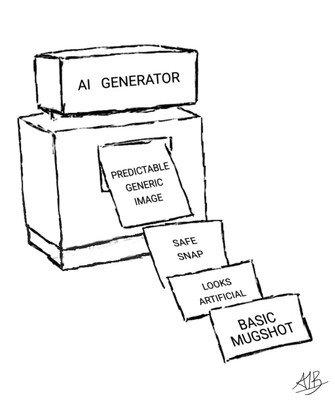
A photographer friend of mine called out another photographer (without naming them) about strange wording on their website that was obviously written by AI. It was meant to be unusual and thought-provoking phrasing promoting wedding photography. Instead, all it did was provoke thoughts about why this person was putting on their website words and phrases that looked obviously AI generated and plastic. The emotion of being a wedding photographer had gone. And that lack of emotion would also be noticed by any potential clients they may have had. When Tools Begin to Think Modern photographers now work with AI at every stage of the process. Cameras identify faces, eyes, animals, and vehicles before the photographer consciously reacts. Autofocus predicts movement. Exposure systems analyse scenes based on thousands of similar images. Noise reduction, sharpening, and lens corrections are applied automatically, often invisibly. In post-production, AI retouches skin, replaces skies, balances colour, selects crops, and suggests edits based on what has performed well elsewhere. In marketing, AI writes captions, generates keywords, schedules posts, and predicts engagement. None of this is inherently negative. Many of these tools save time and reduce friction in professional workflows. The problem arises when assistance becomes substitution. Photography has always been about choice. AI is designed to remove choice. “The thing that makes you successful is not data. It’s original thinking.” — John Hegarty - BBH Advertising Agency Convenience and the Erosion of Intent There is a subtle but crucial difference between using a tool and surrendering judgment to it. When a photographer warms an image to reinforce mood, that is intent. When AI applies warmth because similar images perform well, that is optimisation. Optimisation produces consistency. Intent produces meaning. AI systems are excellent at recognising patterns. They are not capable of understanding why a photographer might deliberately break one. Over time, reliance on AI can shift a photographer’s relationship with their own work. Editing decisions become habits. Visual style becomes less conscious. Images still look polished, but it becomes harder to explain why they look the way they do. This is not creative failure. It is creative drift. The Homogenisation of Visual Style Scroll through social media, advertising campaigns, or even competition entries, and a pattern emerges. Skin tones converge. Colour grading repeats. Lighting styles echo one another. Skies glow with familiar intensity. Retouching follows predictable rules. This isn’t a failure of imagination. It’s a consequence of how AI works. AI does not ask, “Is this interesting?” It asks, “Is this similar to what already works?” AI systems are trained on existing trends and rewarded for reinforcing what already performs well. They don’t ask whether something is interesting or meaningful. They ask whether it’s statistically similar to past successes. Photography does not collapse. It simply flattens. “If you don’t know what you stand for, you’ll end up standing for what works.” Skill Loss: The Quiet Consequence One of the least discussed consequences of heavy AI reliance is skill atrophy. Skills that are not used weaken over time. Photographers who rarely make exposure decisions may struggle in complex or unconventional lighting. Retouchers who rely on AI smoothing may lose the ability to work subtly by hand. Those who outsource all marketing communication to AI risk losing confidence in their own voice. These losses often go unnoticed until something goes wrong. AI performs best in predictable conditions. It struggles with ambiguity, nuance, and emotional subtlety. These are precisely the moments where professional judgment matters most. When creative skills have been neglected, the photographer becomes a software operator rather than an image-maker. Data Is Not Creativity
John Hegarty of the BBH Advertising Agency has long argued that data can tell you what happened, but it cannot tell you what to do next creatively. AI, at its core, is an extension of that same principle. It works by analysing existing information and extrapolating from it. That makes it excellent at optimisation. It does not make it inventive or creative. It makes something by mashing together what has gone before. Eventually, when nothing new is ever created, then it recycles itself. Creativity often involves stepping away from precedent. It requires risk, intuition, and a willingness to ignore what metrics suggest should work. When photographers confuse performance data with creative value, originality becomes secondary. “Originality doesn’t come from following the numbers. It comes from having a point of view.” The Productivity Trap AI is frequently sold as a solution to burnout. Writing all your social media and blogs. Faster edits, quicker turnaround, increased output. But speed and progress are not the same thing. Producing more images does not automatically improve quality. Posting more frequently does not guarantee stronger engagement - actually it’s the opposite. Automating communication does not necessarily build trust. How often do people get annoyed by a chatbot giving an automated reply when trying to connect with a business? Creativity is not efficient by nature. That’s is the very nature of the wonderful and unpredictable beast. It requires experimentation, reflection, and sometimes failure. AI removes friction from the process, but friction is often where learning happens. The author Robert Greene in his best-selling book “Mastery” explains that when we encounter friction and problems, then we begin to think creatively to come up with solutions and through that process we learn. First as novices, then apprentices, and eventually Masters. We all need to encounter friction so that we can learn. We exercise our brains and our creativity. Without that resistance, photographers may become highly productive while becoming creatively stale. They say that AI is “trained” and that it learns. It doesn’t really learn from its own mistakes - it learns from YOUR mistakes. Marketing Without a Voice AI’s influence extends beyond image-making into how photographers present themselves. AI-generated captions, emails, and website copy are usually clear and grammatically correct. They are also often interchangeable and indistinguishable from your competitors. That’s one of many reasons why you shouldn’t use AI to generate your marketing! Over time, a photographer’s brand voice can begin to sound like everyone else’s. A photographer’s voice is an extension of their vision. When that voice is replaced with generic, optimised language, the brand loses texture and personality. Clients may not articulate this consciously, but they feel it. Authenticity builds trust. Automation rarely does. Using AI Without Losing Yourself This is not an argument for rejecting AI. That would be neither practical nor sensible. The question is who remains in control. AI should execute decisions, not define them. It should handle repetition, not replace judgment. It should free up time for thinking, not remove the need for it. I like to think of it as the enthusiastic office junior. You can give them the task of finding about the markets, the competitors, things that people are talking about. They will dutifully go and gather information for you, always eager to please. But you would never ask the office junior to formulate your five-year business strategy. You may use them to sound-out your ideas, and gauge their reaction, but you wouldn’t leave all the decision making to them. That’s what happens when people say that AI can do all their website SEO, blogs and marketing. Ironically, Google Gemini search engine can sniff out these AI written posts and blogs and will downrank them in searches. It values fresh and original content over and above the generalised and formulaic. So, instead of AI solving a problem for you, it can actually cause problems in getting you seen and heard, especially if it is not your voice that is speaking. The Hidden Costs of AI First there is the massive energy consumption every time you use a prompt. Far greater than aeroplane pollution, and the costs of energy generation to power the servers and the water consumption needed for cooling. AI is not environmentally-friendly! There are seven companies listed on the New York Stock Exchange with a combined valuation greater than the GDP of the entire European Union. (BBC Radio 4 Podcast “The Artificial Human” with Aleks Krotoski & Kevin Fong). That is obviously an unrealistic figure. The AI companies lose a lot of money every time you use them, and their losses in the last three months were far greater than their loses in the preceding twelve months. They will eventually have to call time and either charge you a lot of money, or bombard you with advertisements, or put restrictions on usage. No-one knows. Just don’t get too reliant on them. A useful test is simple: If this tool disappeared tomorrow, could I still do the work myself? If the answer is no, dependency has replaced skill. “Tools should amplify talent, not replace it.” Protecting Creative Muscle Memory
Photographers, like any creatives, need to exercise their skills. That may mean occasionally turning off automation. Editing manually. Writing copy from scratch. Creating lists of words with impact and meaning they want to use in their social media posts. Allowing time for experimentation without immediate output. These practices are not nostalgic. They are protective. They ensure that the photographer retains the ability to think visually, solve problems, and adapt when technology falls short. And there are times when it will let you down, and you will have to think on your feet. And how would it be if your legs and feet no longer worked because you failed to exercise? The same with your creativity if you didn’t give it a regular workout. We run a group on Facebook which we call The Photographer’s Gym™. We named it this way for that very purpose. Any of you are welcome to join and participate. It’s free! Like any craft, photography requires practice at the basic level. It is this knowledge that will allow you to go on and create at a much higher level. When you refine your own unique creative visions and voice, and are in control, then you can produce far greater work than any AI program will ever be capable of. Which would you prefer? Why Human Judgment Still Matters Photography’s strength has never been technical perfection. It has always been interpretation. Two photographers can stand in the same place, with the same equipment, and produce entirely different images. That difference is not technology. That difference is human. AI can replicate the style of a photo. It cannot assign meaning and context. That also applies to using AI to produce your marketing materials. As AI-generated imagery becomes more common, work that feels considered, personal, and intentional will stand out more, not less. When you write your social media posts and blogs you should be writing from your heart. THAT will get you noticed! Originality remains a human skill and a skill that is valued and can command respect as well as premium prices. That’s where the real value lies. A Quiet Choice “The impact of new technology is always overestimated in the short term and underestimated in the long term.” Sir John Hegarty AI will continue to evolve. It will become more capable, more integrated, and more persuasive. Avoiding it entirely is unrealistic. But it is the AI companies who tell us that it is here to stay and will never go away. That’s what they tell us. Other experts disagree. My opinion is that it will settle into data processing, medical research, global weather analysis and things like that. Just like lasers became instruments to measure distance, to record time, to perform operations. They never became Death Stars capable of destroying planets. AI will find a quiet and efficient place. But photographers still have a choice. They can allow AI to quietly shape their work, or they can use it deliberately, critically, and selectively. They can trade authorship for convenience, or they can protect the skills that define their craft. The silent killer is not artificial intelligence itself. It is the gradual surrender of creative responsibility. And that remains a choice made one image at a time.
Questions to Ask Before Using AI 1. What decision is this tool making for me? Be clear about what you’re handing over. Is AI adjusting exposure, choosing a crop, retouching skin, or shaping your messaging? If you can’t identify the decision, you’re probably surrendering more control than you think. 2. Do I understand why this result looks the way it does? If you can’t explain an edit, a colour choice, or a retouching outcome, you’re no longer authoring the image. Understanding matters more than efficiency. 3. Could I achieve something similar without this tool? You don’t need to reject AI, but you should retain the ability to work without it. If the tool vanished tomorrow, could you still deliver professionally? 4. Am I choosing this because it fits my vision, or because it’s convenient? Convenience is seductive. Vision requires effort. The two are not the same, and confusing them leads to creative drift. You may lose your own voice. 5. Is this making my work more personal, or more generic? AI is trained on what already exists. Ask whether it’s reinforcing your voice or quietly sanding it down. It is mass-producing images or marketing words that sound similar? 6. Am I still practicing the fundamentals? Automation can weaken skills over time. Are you still making exposure decisions, retouching manually, and writing in your own voice often enough to stay sharp? 7. Would I make the same choice if no one ever saw the metrics? Likes, engagement, and performance data are useful, but they are not creative goals. Remove the numbers and ask whether the decision still feels right. 8. Is this saving me time, or replacing my judgment? Time saved is valuable. Judgment surrendered is not. The difference between the two is where professionalism lives and thrives. 9. Does this tool challenge me, or make me comfortable? Growth usually comes from friction. If a tool removes all discomfort, it may also be removing opportunities to improve. 10. Who is leading this process — me or the software? This is the simplest and most important question. AI should serve your thinking, not replace it.
Comments
No comments posted.
Loading...
|